
Best Oral Probiotics for Bad Breath: What Actually Works
Disclosure: This article contains affiliate links. If you purchase through my link, I may earn a commission at no extra cost to you. I only recommend products I have personally tested and believe in. — Sarah Mitchell
⚡ Quick Answer
The best oral probiotics for bad breath contain strains that colonize the mouth directly — specifically Lactobacillus reuteri, Lactobacillus paracasei, and Bifidobacterium lactis BL-04®. These strains have the strongest clinical evidence for reducing volatile sulfur compounds (the primary cause of halitosis), lowering gum inflammation, and rebalancing the oral microbiome. Standard gut probiotics in capsule form provide zero oral benefit — delivery method is everything. Look for a slow-dissolve lozenge or chewable tablet with at least 3 billion CFU and documented oral-specific strains. Bad breath that returns within hours of brushing is almost always a microbial imbalance problem, not a hygiene problem.
👇 Keep reading for the full strain breakdown, comparison tables, research summary, and FAQ.
Looking for a probiotic with all 3 of these strains, at the right CFU count, in the right delivery format?
If you are searching for an effective oral probiotic for halitosis, here’s something your dentist probably never told you — chronic bad breath isn’t just about trapped food. For decades, the entire dental industry was built around a single, seductive idea: a clean mouth is a sterile mouth. Kill the bacteria. All of it. Scrub, rinse, and disinfect with harsh chemicals.
It sounds logical. It’s also, according to modern microbiology, fundamentally wrong.
The hidden truth is this: your mouth is home to over 700 species of bacteria, and the vast majority of them aren’t your enemies — they’re your allies. When you wage chemical warfare on your entire oral ecosystem every single day with alcohol-based mouthwashes, you don’t just eliminate the bad actors. You wipe out the entire community — including the beneficial bacterial populations that were keeping your breath fresh and your mouth healthy in the first place.
Key insight: Bad breath that returns within hours of brushing is not a hygiene failure — it is a signal that your oral microbiome is dominated by the wrong bacterial populations. No amount of brushing fixes a microbial imbalance.
Why Your Mouth Needs ‘Good Bacteria’
In a well-balanced oral microbiome, beneficial bacteria perform a remarkable range of protective functions to keep odor away:
- Competitive exclusion: Crowds out volatile sulfur-producing pathogens — the primary drivers of chronic bad breath.
- pH regulation: Neutralizes the acidic byproducts that erode enamel and cause decay.
- Immune modulation: Helps calibrate the inflammatory response in your delicate gum tissue.
- Pathogen defense: Produces natural antimicrobial compounds that target harmful species.
The oral microbiome is not a problem to be eliminated — it is a system to be managed. The goal is not a sterile mouth; the goal is a balanced mouth where beneficial bacteria outnumber harmful ones.
What Causes Bad Breath Even After Brushing?
If your breath smells bad within an hour or two of brushing, toothpaste and mouthwash are not your solution. The root cause is almost always microbial. Here is what is actually happening inside your mouth:
Volatile Sulfur Compounds (VSCs)
The primary chemical cause of bad breath is a family of gases called volatile sulfur compounds — most notably hydrogen sulfide and methyl mercaptan. These are produced when anaerobic (oxygen-hating) bacteria break down proteins and amino acids in your mouth. These bacteria thrive in the warm, protein-rich environment of your tongue coating, between your teeth, and in deep gum pockets. Brushing temporarily reduces their population, but without a competing beneficial bacterial community in place, they recolonize within hours.
A Disrupted Oral Microbiome
When beneficial bacterial populations are depleted — by alcohol-based mouthwash, antibiotics, or a high-sugar diet — the sulfur-producing pathogens face no competition. They expand rapidly, producing increasing volumes of VSCs, and the cycle of chronic halitosis becomes self-reinforcing. This is why the oral microbiome and bad breath are so deeply connected — and why effective oral probiotics must address this imbalance directly.
Dry Mouth
Saliva is your mouth’s natural antimicrobial defense system. It contains enzymes, immunoglobulins, and oxygen that actively suppress anaerobic bacteria. When saliva production drops — due to mouth breathing, medication side effects, or dehydration — anaerobic bacteria proliferate rapidly and VSC production spikes. Persistent morning breath is almost always a dry-mouth phenomenon amplified by microbial imbalance. The relationship between dry mouth and oral health is one of the most underappreciated drivers of chronic halitosis.
Tongue Coating
The surface of the tongue is the single largest reservoir of VSC-producing bacteria in the mouth. Its irregular surface provides thousands of micro-shelters where anaerobic bacteria can hide from brushing, rinsing, and even tongue scraping. Without beneficial bacteria actively competing for those colonization sites, odor-producing strains dominate the tongue biofilm. What a coated tongue reveals about your oral microbiome goes much deeper than most people realize.
Gum Disease
Even mild, early-stage gum disease creates deep pockets between the tooth and gum tissue — perfect anaerobic environments for pathogenic bacteria to flourish out of reach of any conventional hygiene tool. Bleeding gums are almost always present when gum-disease-driven halitosis is the underlying cause. Understanding why your gums bleed can help you identify where you currently stand.
Brushing addresses the symptom. Rebalancing the oral microbiome addresses the cause. That is why people who brush twice a day and floss still suffer from chronic bad breath — they are fighting the wrong battle with the wrong tools.
3 Signs Your Oral Microbiome Is Out of Balance
1. Persistent Bad Breath
Chronic halitosis that returns within hours of brushing is one of the clearest indicators of oral microbial imbalance. Reaching for antibacterial mouthwash temporarily masks the symptom while deeply worsening the root problem. If this sounds familiar, the number one reason your breath smells bad may not be what you think.
2. Gums That Bleed Easily
Healthy gum tissue should not bleed from normal brushing. Bleeding gums are a sign of inflammation — almost always microbial in origin. Accepting them as inevitable is one of the most common mistakes people make.
3. Frequent Cavities Despite Good Hygiene
If you brush, floss, and watch your sugar intake but still get cavities, the answer may lie in your microbial balance rather than your hygiene habits. How sugar destroys your oral microbiome explains the mechanism in detail.
What Are the Best Oral Probiotics for Bad Breath?
Not all probiotic strains are equal — and most strains studied for gut health have no documented effect on the oral microbiome whatsoever. The strains below represent the strongest available evidence for oral-specific benefit, based on peer-reviewed clinical literature. For a full explanation of why gut probiotics don’t work for oral health, see gut probiotics vs oral probiotics.
Lactobacillus reuteri
Lactobacillus reuteri is one of the most extensively studied probiotic strains for oral health. Research suggests it produces a natural antimicrobial compound called reuterin that selectively inhibits pathogenic bacteria while leaving beneficial species intact. Studies indicate that regular use of L. reuteri lozenges significantly reduces gingival inflammation scores and lowers the concentration of volatile sulfur compounds responsible for halitosis. It is particularly well studied for its effect on gum disease, with evidence showing meaningful reductions in bleeding on probing — a key clinical marker of gum health — after consistent use.
Lactobacillus paracasei
Lactobacillus paracasei demonstrates a specific and well-documented mechanism against Candida albicans (oral yeast) and against Streptococcus mutans, the primary bacteria responsible for tooth decay. Research suggests it reduces the ability of harmful bacteria to adhere to tooth surfaces and soft tissue — a process called anti-adhesion — which limits their ability to form the biofilm communities where they thrive and produce odor-causing compounds. Evidence shows it also supports salivary immunoglobulin A (IgA) levels, strengthening the mouth’s first-line immune defense.
Bifidobacterium lactis BL-04®
Bifidobacterium lactis BL-04® is a precision-characterized strain with a strong safety and efficacy profile. Studies indicate it modulates the inflammatory response in mucosal tissue — which is particularly relevant for gum health — and supports a balanced immune reaction to the bacterial populations living in the oral cavity. Evidence shows it contributes to an overall shift in the oral microbial community toward a less inflammatory, more balanced composition, which directly benefits breath quality and gum tissue integrity.
The three strains most consistently supported by clinical research for oral health are Lactobacillus reuteri, Lactobacillus paracasei, and Bifidobacterium lactis BL-04®. A product that does not contain at least one of these — delivered in a format that dissolves in the mouth — is unlikely to produce meaningful results for halitosis.
Found a product with all three strains?
Not so fast.
Most products fail on ONE critical factor…
Natural Habits to Support Your Oral Flora
Beyond taking an oral probiotic supplement, these daily habits help the beneficial strains thrive:
- Fermented foods: Yogurt, kefir, and kimchi introduce beneficial Lactobacillus strains naturally.
- Fiber-rich vegetables: Stimulate healthy saliva production and provide prebiotic fiber.
- Reduce processed sugars: Sugars are the preferred fuel for acid-producing pathogens. Some foods are actively destroying your teeth without you realizing it.
- Stay hydrated: Saliva is the oral microbiome’s primary support system.
Oral Probiotics vs Mouthwash
This is the comparison most people never think to make — because for decades, mouthwash was presented as the gold standard of fresh breath. The reality is considerably more complicated.
Conventional alcohol-based mouthwash operates on a scorched-earth model: kill everything, rinse, repeat. It does temporarily reduce bacterial counts — including the VSC-producing bacteria responsible for bad breath. But it does not discriminate. Within two to four hours, bacterial populations begin to recolonize the now-cleared oral environment. Without a resident beneficial bacterial community to slow their return, the pathogenic strains that produce odor frequently recolonize faster than the beneficial ones — leaving the mouth in a worse microbial position than before rinsing. This is sometimes called the “mouthwash rebound effect.” The same principle applies to antibacterial toothpaste. If you have been using both daily, here is what actually happens when you stop using mouthwash
Oral probiotics operate on the opposite model: rather than clearing the field, they introduce competitive beneficial strains that gradually shift the balance of the oral ecosystem away from pathogenic dominance. The effect is slower to build — but it addresses the underlying cause rather than the surface symptom.
Mouthwash and oral probiotics are not interchangeable — they operate on fundamentally different principles. Mouthwash is a temporary suppression tool. Oral probiotics are a long-term ecosystem restoration tool. Using both simultaneously is counterproductive: the mouthwash will kill the probiotic strains before they can colonize.
The Role of Targeted Oral Probiotics
Standard probiotic capsules pass through your mouth in seconds and deliver zero benefit to your oral ecosystem. True oral-specific probiotics dissolve in the mouth, delivering beneficial strains directly where they need to colonize. The delivery method matters just as much as the formula itself.
The specific strains with the most evidence for oral health include Lactobacillus reuteri, Lactobacillus paracasei, and Bifidobacterium lactis BL-04® — all clinically studied for their ability to reduce gum inflammation, fight bad breath, and rebalance the oral microbiome.
Why Delivery Method Matters
This is the detail that separates genuinely effective oral probiotics from expensive placebos. Probiotic bacteria can only colonize a surface they have direct, sustained contact with. A capsule swallowed whole makes contact with the oral cavity for approximately three seconds — nowhere near long enough for any colonization to occur. The bacteria travel immediately to the gut, where they may or may not thrive, but they will have contributed nothing to your oral microbiome.
True oral-specific probiotics are designed to dissolve slowly in the mouth — typically over five to ten minutes — in the form of a lozenge, chewable tablet, or dissolvable strip. During that dissolution window, billions of live bacterial cells are released directly onto the tongue, gum tissue, and mucosal surfaces — precisely where they need to establish themselves to displace the pathogenic bacteria producing your bad breath. The longer the contact time, the greater the opportunity for colonization.
The delivery format of an oral probiotic is not a minor packaging detail — it is the single most important functional variable. A product with excellent strains in a swallowable capsule is essentially useless for oral health. The strains must be delivered where they are needed: directly in the mouth.
After taking an oral probiotic, avoid eating, drinking, or rinsing for at least 20–30 minutes to give the bacterial strains the best possible opportunity to adhere to oral surfaces. Rinsing immediately after use removes the bacteria before they can establish a foothold.
Why CFU Count Matters
CFU stands for colony-forming units — the measure of how many live, viable bacteria are present in each dose. For oral health applications, research suggests that a minimum threshold of approximately 1 billion CFU per dose is needed to produce a meaningful effect on the oral microbiome. Below that threshold, the introduced bacteria are simply too outnumbered by the existing microbial population to shift the balance in any clinically relevant way.
The most well-studied oral probiotic protocols use doses in the range of 3 to 3.5 billion CFU — high enough to introduce a significant competing population without overwhelming the beneficial bacteria already present. Higher is not always better: extremely high CFU counts in oral formulations have not been shown to produce proportionally greater benefit, and the focus should be on strain specificity and delivery format rather than raw CFU maximization.
What matters is that the CFU count is measured at the product’s expiration date — not at the time of manufacture. Many probiotic products list an impressive CFU count at manufacture that degrades significantly by the time the product reaches you. A reputable oral probiotic will guarantee CFU viability through the end of shelf life.
For oral probiotics, the sweet spot supported by current research is approximately 3 billion CFU of oral-specific strains, delivered via slow-dissolve format, taken consistently once or twice daily. This is the protocol that has produced the most reproducible results across available clinical studies.
Ready to See Real Results?
I documented the exact timeline of what happened when I tested this protocol for 60 days.
How Long Do Oral Probiotics Take to Work?
This is the most common question — and the honest answer is: it depends on how disrupted your oral microbiome is to begin with. Someone who has used alcohol-based mouthwash daily for ten years has a substantially more depleted beneficial bacterial community than someone who has not. That said, here is what the available evidence suggests as a realistic timeline:
Days 1–3: Initial Colonization
The introduced strains begin adhering to oral surfaces and establishing initial population footholds. Most people do not notice any change during this phase. The bacterial community is in a state of competitive flux. Consistency is critical — skipping days during this phase significantly delays colonization.
Week 1–2: Early Signs of Balance
Research suggests that measurable reductions in volatile sulfur compound concentrations can begin as early as seven to fourteen days of consistent use. Some users report that breath stays fresher for longer periods between meals — a sign that VSC-producing bacteria are being displaced. Gum tissue may begin to feel less tender or sensitive.
Weeks 3–4: Noticeable Improvement
By the end of the first month, most users report consistent improvement in breath freshness. Studies indicate that gum bleeding scores begin showing meaningful reductions around this timeframe. The beneficial bacterial community is now established enough to actively compete with pathogenic strains on an ongoing basis.
Weeks 8–12: Microbiome Rebalancing
Evidence shows that significant, measurable shifts in the composition of the oral microbiome occur between eight and twelve weeks of consistent use. This is the window in which the intervention moves from symptomatic management to genuine ecosystem restoration. Breath improvement at this stage tends to be stable between doses.
3+ Months: Sustained Results
Users who maintain consistent daily use for three or more months report the most durable results — fresh breath that persists throughout the day, reduced gum sensitivity, and a general improvement in overall oral comfort. At this stage, some individuals successfully maintain results with a reduced maintenance dose, though stopping entirely may allow the microbiome to gradually drift back if underlying dietary habits have not changed.
Oral probiotics are not a fast-acting breath freshener — they are a slow-acting ecosystem intervention. The people who get the best results treat it like a supplement protocol: consistent daily use, ideally at the same time each day, without interruption for at least 60–90 days.
What Does the Research Say?
The science of oral probiotics is younger than gut probiotic research, but it is growing rapidly. Here is what the available clinical literature currently indicates — presented with appropriate caution, because the field is still evolving and study populations are often small.
On Bad Breath and VSC Reduction
Research suggests that oral administration of Lactobacillus reuteri produces statistically significant reductions in organoleptic breath scores — the clinical measure of breath odor judged by trained assessors — compared to placebo. Studies indicate these reductions are associated with measurable decreases in hydrogen sulfide and methyl mercaptan concentrations in oral air samples. Evidence shows that the effect is delivery-dependent: oral lozenges outperform swallowable capsules in all available comparative studies. This is why effective oral probiotics are always available in slow-dissolve formats, never as swallowable capsules.
On Gum Health and Inflammation
Multiple randomized controlled trials suggest that Lactobacillus reuteri supplementation via oral lozenges produces meaningful reductions in gingival index scores — the clinical measure of gum inflammation — as well as reduced bleeding on probing compared to placebo groups. Studies indicate that these improvements appear in both otherwise healthy adults and in populations with diagnosed gingivitis. Research suggests the mechanism is primarily immune-mediated: the probiotic strains appear to modulate the gum tissue’s inflammatory response to bacterial biofilm rather than simply reducing bacterial count.
On Pathogenic Bacteria Suppression
Evidence shows that consistent use of oral probiotic strains — particularly Lactobacillus paracasei — is associated with reduced salivary counts of Streptococcus mutans, the primary cariogenic (cavity-causing) bacterium in the human mouth. Studies indicate this reduction is achieved through competitive exclusion and anti-adhesion mechanisms rather than direct antimicrobial activity, which means the intervention selectively targets harmful species without broadly suppressing the oral microbiome.
On the Limits of Current Research
It is important to note that most available studies on oral probiotics are small in scale, short in duration, and conducted by research teams with varying methodological standards. Research in this area is promising but not yet definitive. The strains with the strongest evidence base — L. reuteri, L. paracasei, and B. lactis BL-04® — represent the most reasonable current choices based on available data, but the field is actively developing and recommendations may evolve as larger trials are completed.
The current body of evidence on oral probiotics is encouraging and mechanistically coherent — but consumers should approach product claims with critical thinking. Strain identity, delivery format, and CFU viability are the variables that separate genuinely effective products from marketing noise.
Taking the Next Step
Your oral microbiome is one of the most powerful and most overlooked systems in your body. Now that you know how it works — you have everything you need to start working with it instead of against it to reclaim clean, fresh breath naturally.
If you are ready to stop the cycle and see the exact 3.5 Billion CFU probiotic protocol used to permanently rebalance your oral microbiome, you can read the full, unfiltered clinical review.
Frequently Asked Questions
Are oral probiotics the same as regular probiotic supplements?
No — and this distinction matters enormously. Regular probiotic supplements are formulated for the gut. They are swallowed quickly, bypass the oral cavity almost entirely, and contain strains selected for intestinal colonization. Oral probiotics are specifically formulated to dissolve in the mouth, delivering strains — such as Lactobacillus reuteri and Lactobacillus paracasei — that are capable of colonizing oral surfaces. Using a standard gut probiotic capsule and expecting oral health benefits is like applying a skin cream to your stomach and expecting it to moisturize your face. For a full comparison, see gut probiotics vs oral probiotics.
Can I use mouthwash and oral probiotics at the same time?
Using them simultaneously is counterproductive. Alcohol-based mouthwash kills bacteria without discrimination — which means it will kill the beneficial probiotic strains you just introduced before they have a chance to colonize. If you want to continue using mouthwash, use it at a different time of day and allow several hours between mouthwash use and your oral probiotic dose. Many oral health researchers suggest phasing out alcohol-based mouthwash entirely during an oral probiotic protocol, given that the two approaches work on opposing principles. Alcohol-free mouthwash is significantly less disruptive and may be a reasonable compromise.
How many CFU should an oral probiotic have?
Research suggests that a minimum of 1 billion CFU per dose is necessary to produce any meaningful effect on the oral microbiome. The most clinically studied protocols use doses in the range of 3 to 3.5 billion CFU. This appears to be an effective range that introduces a competitive bacterial population without being excessive. More important than a high CFU count is that the CFU viability is guaranteed through the product’s expiration date — not just at the time of manufacture — and that the strains are genuinely oral-specific rather than gut strains repurposed in oral-format packaging.
How long does it take for oral probiotics to work?
Most people begin to notice improvements in breath freshness within one to two weeks of consistent daily use. More significant changes in gum tissue health and overall oral microbial balance develop over four to twelve weeks. The most durable and meaningful results appear in people who maintain consistent use for at least 60 to 90 days. Results vary based on the severity of the initial microbial imbalance, diet, hydration habits, and whether disrupting factors — like alcohol mouthwash or antibiotic use — are removed from the equation.
What causes bad breath even after brushing?
Bad breath that returns quickly after brushing is almost always caused by volatile sulfur compounds (VSCs) produced by anaerobic bacteria living in the tongue coating, between teeth, and in gum pockets. Brushing temporarily reduces these bacterial populations, but without a competing community of beneficial bacteria to slow their return, they recolonize rapidly. The solution is not more brushing — it is rebalancing the microbial community so that VSC-producing pathogens are kept in check by beneficial competing strains.
Do oral probiotics help with bleeding gums?
Yes — research shows that specific oral probiotic strains, particularly Lactobacillus reuteri, significantly reduce gum bleeding and inflammation. The mechanism is immune-mediated: beneficial bacteria help calibrate the gum tissue’s inflammatory response to bacterial biofilm. If your gums bleed during normal brushing, this is a sign of microbial imbalance and inflammation — not a hygiene failure. Learn more about the 3 probiotic strains that fight bad breath.

Sarah Mitchell
Health Researcher & Oral Wellness Writer — University of Texas, Nutritional Biology
Sarah spent over 8 years diving into nutritional biology research so you don’t have to read the boring clinical trials. Based in Texas, she has zero patience for wellness fads—no oil pulling, no charcoal toothpaste—and focuses strictly on evidence-based routines that actually rebuild the oral microbiome.
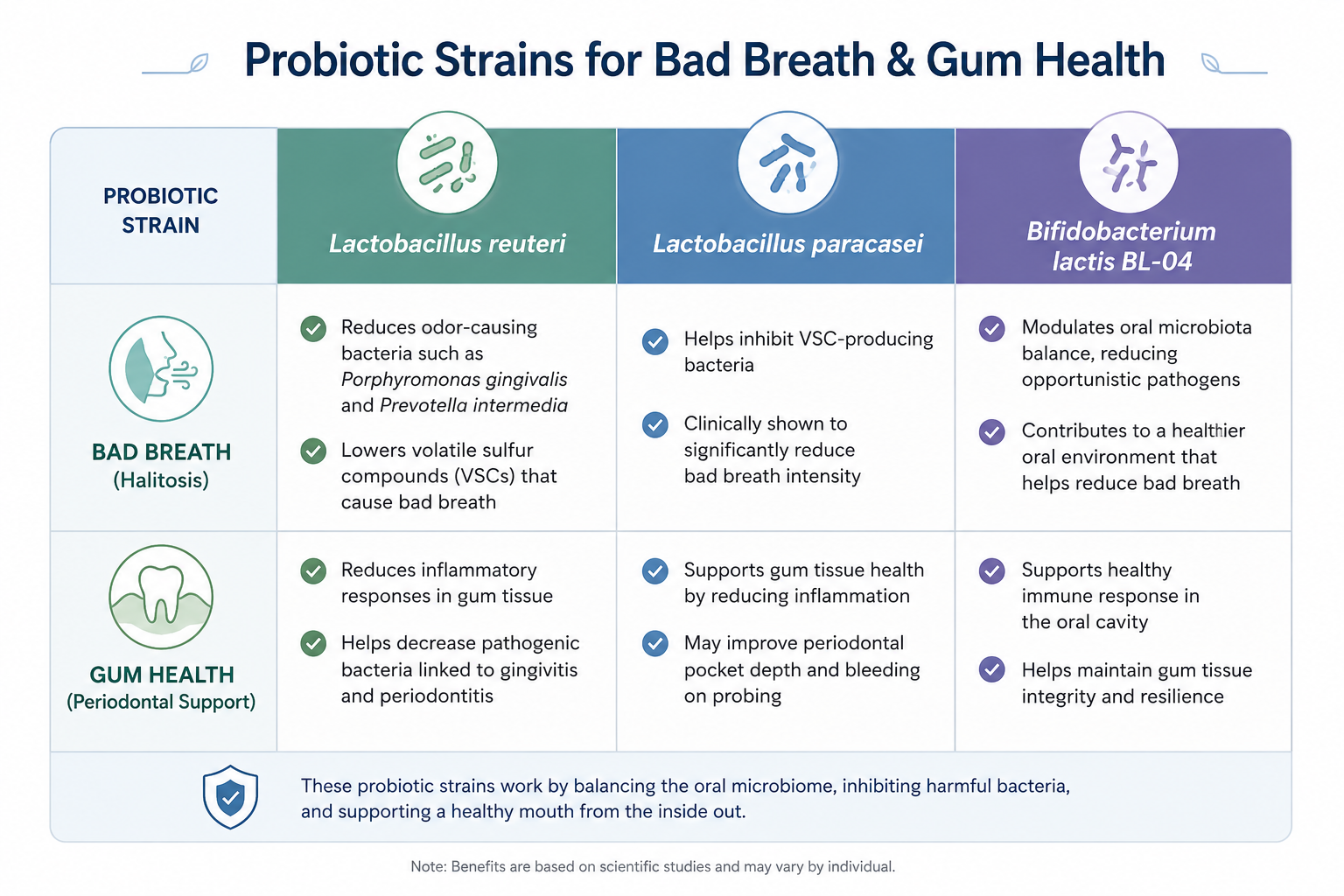
Clinical strains in effective oral probiotics work through different mechanisms to rebalance the oral microbiome.
⚠️ Still Dealing With Gum Issues or Bad Breath?
I Stopped My Gums From Bleeding in 19 Days
Using this exact oral probiotic protocol — no mouthwash, no gimmicks, just clinical evidence and real results.
✅ See the Oral Probiotic Protocol That Worked →
60-day money-back guarantee · Ships worldwide · Verified formula